Audit Canonicals, Redirect Chains and Internal Links from CSV
Inspect supplied crawl snapshots while separating recorded errors from unverified targets.
Capture a snapshot with a date
Use a crawl export from the site and record when it was collected. These local tools cannot reliably trace arbitrary live websites across browser security boundaries. They analyze the rows you supply, with exact CSV headers shown in their examples. Keep the original export unchanged and work on a sanitized subset first. A successful local parse says the data has the required shape, not that it still describes the live site.
Compare canonicals with stated intent
The canonical checker uses URL,Canonical,Expected,Status. Its example has two recorded 200 pages. Page a declares the intended page a canonical; page b declares page a while its Expected value is page b. One row therefore needs review. This does not imply every page must be self-canonical. Put the actual intended target in Expected and investigate cross-origin declarations deliberately. Target indexability and Google’s selected canonical are separate checks.
Trace the recorded chain
The redirect example uses URL,Status,Location. /old records a 301 to /new, /new records a 302 to /final, and /final records 200. The first chain has two recorded hops. Relative locations resolve against their source URL. A chain that revisits a URL is reported as a recorded loop; a target absent from the export is unverified. The tool does not invent a final success or follow JavaScript and meta-refresh redirects.
| Finding | Meaning | Next check |
|---|---|---|
| Canonical differs from Expected | Recorded declaration conflicts with supplied intent | Current page and target eligibility |
| Recorded redirect loop | Supplied chain revisits a URL | Live redirect behavior |
| 404 or 410 record | Snapshot reports a missing target | Current response and source link |
| 403 record | Access/client error | Permissions or request restrictions |
| Target absent | Evidence missing | Collect the target response |
A snapshot is dated evidence, not continuous monitoring.
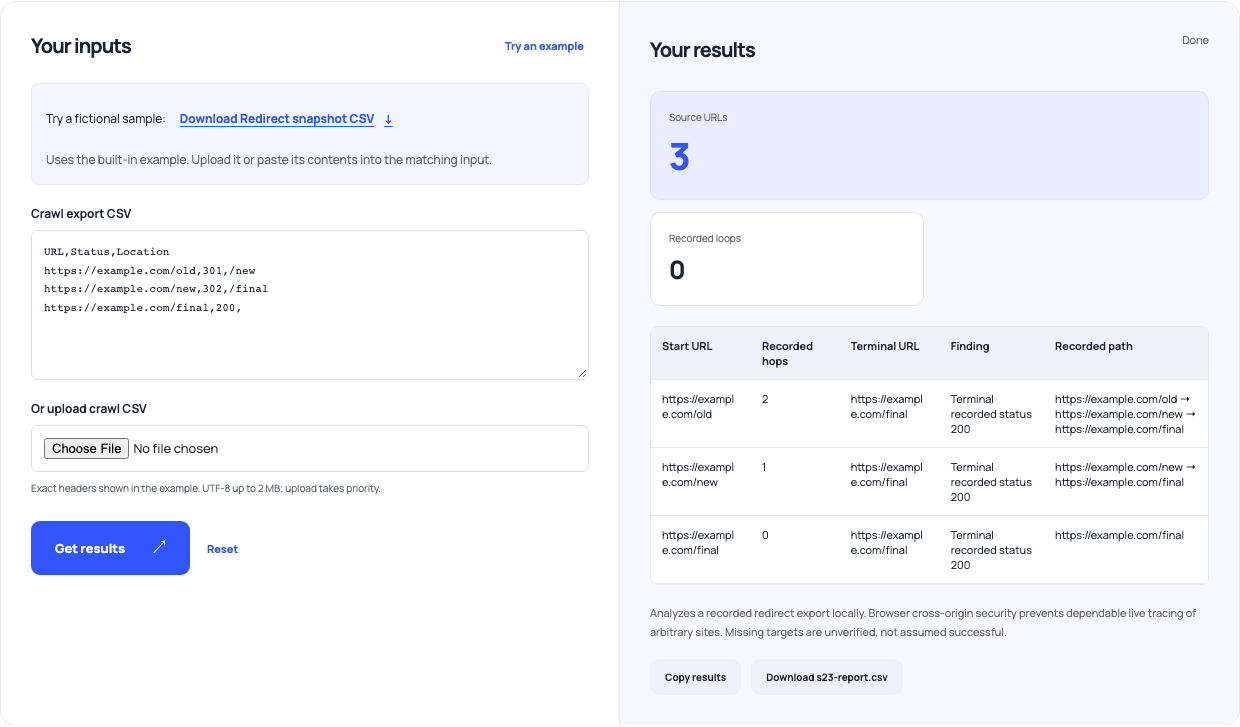
Use this example Opens Redirect chain checker with these inputs.
Join links with recorded responses
The broken-link example supplies page HTML linking to /about/, /missing/ and an external host, plus URL,Status records. It reports /about/ as recorded success and /missing/ as recorded 404, ignoring the external link. A 403 is an access/client error to review, not automatically a missing page. A link without a supplied status remains unverified. Fragment existence and links created by scripts are outside this HTML-source check.
Confirm changes against the live site
Recheck recorded 404/410 results, blocked requests and chains before changing navigation or redirects. Compare intended canonical targets with current responses and content. Export a new snapshot after fixing the actual site and run the same local checks again. Keep the before and after data with the decision; an old crawl can support an investigation, but it should not silently become a current site-health claim.