Cups to Grams, Serving Scaling and Cake-Pan Conversions
Use named ingredient equivalents and pan geometry without scaling baking time mechanically.
Choose a named ingredient equivalent
A cup is a volume, so its gram weight depends on the ingredient and preparation. The ingredient converter uses selected King Arthur Baking chart equivalents, not measured density. One chart cup of all-purpose flour is 120 g; one of butter is 226 g. Packed brown sugar and unsifted confectioners sugar require the named preparation. These chart cups are not a 250 mL metric-cup conversion. Weigh directly where practical.
Scale the structured ingredient list
The serving scaler example starts with flour 240 g, eggs 2 whole and milk 150 ml for four servings. Set target servings to six: the multiplier is 1.5, giving 360 g flour, 3 eggs and 225 ml milk. The CSV uses Ingredient,Quantity,Unit; quantities are decimals and labels remain unchanged. It does not parse recipe prose or convert units. A different ratio can produce fractional eggs that need your own portioning decision.
Compare the pan geometry
The pan calculator example changes an 8-inch round pan to a 9 by 9-inch rectangle at equal intended batter depth. The round area is π × 4², about 50.2655 square inches; the rectangle is 81. The area and volume multiplier is about 1.611444. Enter internal dimensions in one unit and use intended batter depth, not total pan height. The tool models simple cylinders and rectangular prisms, not tapered or shaped pans.
| Question | Example | Result |
|---|---|---|
| What does one flour cup weigh? | Named chart equivalent | 120 g |
| What does one butter cup weigh? | Named chart equivalent | 226 g |
| Four servings to six | 6 ÷ 4 | Multiply ingredients by 1.5 |
| 8-inch round to 9 × 9 pan | 81 ÷ (π × 4²), equal batter depth | Multiply batter by about 1.611444 |
Use the chart’s preparation and cup conventions; cooking time does not scale mechanically.
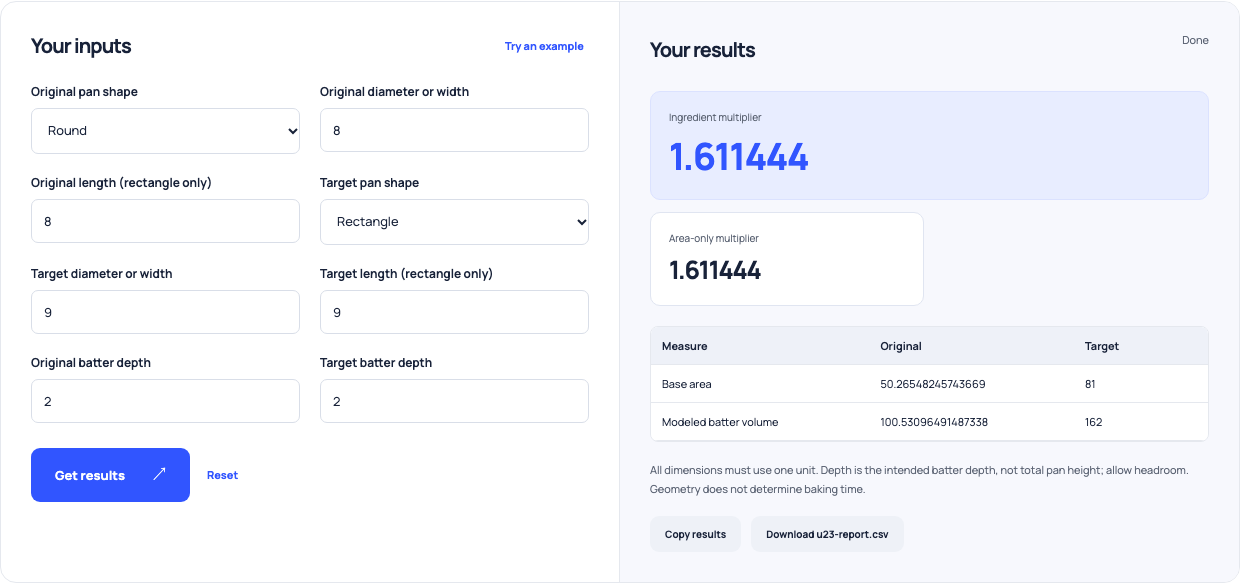
Use this example Opens Cake pan size with these inputs.
Do not multiply the cooking time
Ingredient quantities and geometric volume can be scaled mathematically, but heat transfer, rise, seasoning and doneness do not follow one universal multiplier. Leave headroom in the pan and use recipe-specific guidance for changed thickness or vessel material. The calculator does not recommend a baking duration or temperature. Keep the serving and pan multipliers separate so you do not accidentally apply both when they describe the same desired quantity change.
Test the adapted recipe deliberately
Keep the original ingredient amounts, the chosen multiplier and any practical rounding in your notes. Check that the target pan can hold the batter with room for rise. Observe doneness using the recipe’s appropriate method instead of waiting a mechanically scaled time. A useful first adaptation is small enough to review, with weighing and repeatable measurements, rather than treating a precise-looking geometric factor as a guarantee of the same cake.