Cash runway and hiring impact: calculate burn and compare scenarios
Build a cash-based runway baseline, add salary and one-time hiring costs at the correct time, and distinguish a constant-burn estimate from a dated cash forecast.
Use available cash and actual cash movements
Cash runway compares available cash with the rate at which the business spends more cash than it receives. Start with money you can actually use, excluding balances restricted for another purpose. Enter expected collections and payments rather than invoiced revenue and non-cash accounting charges. A profitable project can still create a cash gap if payment arrives after payroll. The runway calculator assumes an unchanged monthly pattern with cash moving evenly through each month. Treat that as a baseline for comparing scenarios, then use a dated forecast when payment timing matters to a decision.
Establish a ten-month baseline
Suppose available cash is 150,000, monthly cash collections are 25,000 and monthly cash expenses are 40,000. Net burn is 15,000 per month, giving ten months of runway. Enter a twelve-month projection in the cash runway calculator and the modeled final balance is negative 30,000. That negative figure describes a funding deficit if the assumed operations continue. It is not usable cash or permission to spend beyond the available balance. Save this baseline before adding a hire, because it makes the incremental effect of the decision visible.
| Projection point | Modeled cash |
|---|---|
| Start | 150,000 |
| After 5 months | 75,000 |
| After 10 months | 0 |
| After 12 months | −30,000 funding deficit |
Monthly collections are 25,000 and expenses 40,000. A negative forecast is a funding gap.
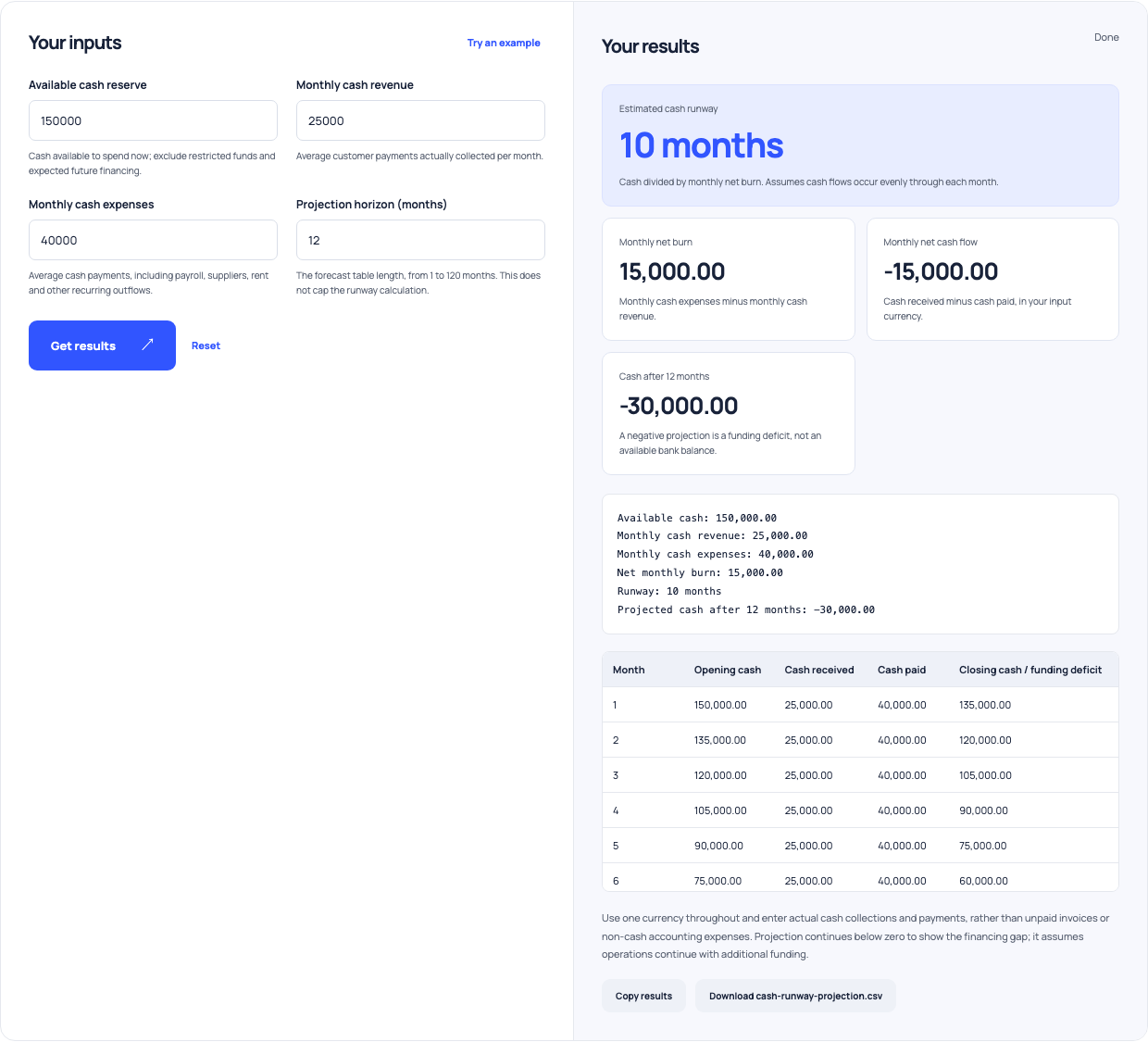
Use this example Opens Cash runway with these inputs.
Add salary, overhead and the start month
Now model a hire starting in month four with annual salary 72,000, added employer-cost allowance 25% and one-time recruiting cost 7,500. Loaded monthly salary becomes 7,500. The hiring impact calculator applies recruiting expense at the start of month four and salary from that month onward. Using the same cash baseline and a twelve-month horizon, it returns about 7.33 months of runway instead of ten. The reduction is about 2.67 months. Additional modeled spending across the horizon is 75,000: nine salary months plus the recruiting charge.
Read the month where cash runs out
The first three baseline months consume 45,000, leaving 105,000 at the beginning of month four. The recruiting payment reduces that to 97,500. Monthly net burn with the hire becomes 22,500, so the remaining amount supports about 4.33 more months under the even-flow assumption. Total runway is therefore about 7.33 months. Actual payroll dates and large customer payments can create an earlier intra-month cash low. Read the schedule as an illustration of the entered timing, then map the relevant bills and collections onto calendar dates before committing to the plan.
Do not assume the hire immediately pays for itself
The hiring comparison holds baseline collections constant. A new salesperson, operator or developer may change revenue or capacity, but that is a separate scenario with its own timing and evidence. Write a conservative collection case, an expected case and a delayed case rather than adding an unexplained revenue increase in the hire month. If training temporarily reduces another employee’s productive time, consider that operational effect as well. Keep the cost-only comparison visible so a proposed revenue benefit does not hide the cash commitment that occurs even if the expected sales arrive late.
Test collection timing with milestone payments
For a project business, a deposit can reduce the cash spent before a customer pays. The project deposit and milestone payment calculator allocates a fee into an upfront deposit and shares of the remaining balance. Its output is a payment schedule, not proof of customer collection on those dates. Place the agreed due dates and realistic payment delays in your cash forecast. A 10,000 contract with a 30% deposit supplies 3,000 only when received, while later milestones allocate the remaining 7,000. Avoid counting the full signed contract value as available cash.
Keep cash-positive and short-horizon results bounded
If monthly collections equal or exceed expenses, a constant-burn calculation has no finite depletion point under those assumptions. That does not establish permanent financial security: a one-time purchase or collection delay can change the picture. Similarly, a hiring result labeled beyond the selected horizon only means depletion was not observed within that bounded projection. Extend the forecast if the commitment lasts longer. Do not interpret a short favorable window as evidence of unlimited runway. Check known renewals, equipment purchases, financing payments and seasonal changes outside the displayed months.
Set decision dates before the cash limit
Turn the scenario into a calendar with the hire start, major payment dates, expected collection dates and the point when another financing or spending decision must be made. Leave time for the actions your business actually needs, such as renegotiating an order or securing funding; choose that buffer from circumstances rather than a universal rule. Review the forecast when collections, costs or hiring plans change. Compare observed cash movement with the saved baseline so errors become visible early. The practical result is a dated decision process supported by consistent scenarios, not merely a runway number.