Debt Snowball vs Avalanche with a Fixed Monthly Budget
Compare repayment priorities with the same balances, budget and fixed-minimum assumptions.
Use one consistent debt snapshot
Enter each balance, nominal annual rate and minimum payment from a matching point in time. The CSV uses Name,Balance,APR,Minimum and needs unique names. This model holds minimums fixed until a debt’s capped final payment, unlike many real cards whose minimums vary. It assumes no new spending, fees or promotional-rate changes. Keep the snapshot and those limitations with the output rather than treating the result as a creditor’s schedule.
Reproduce the two-card inputs
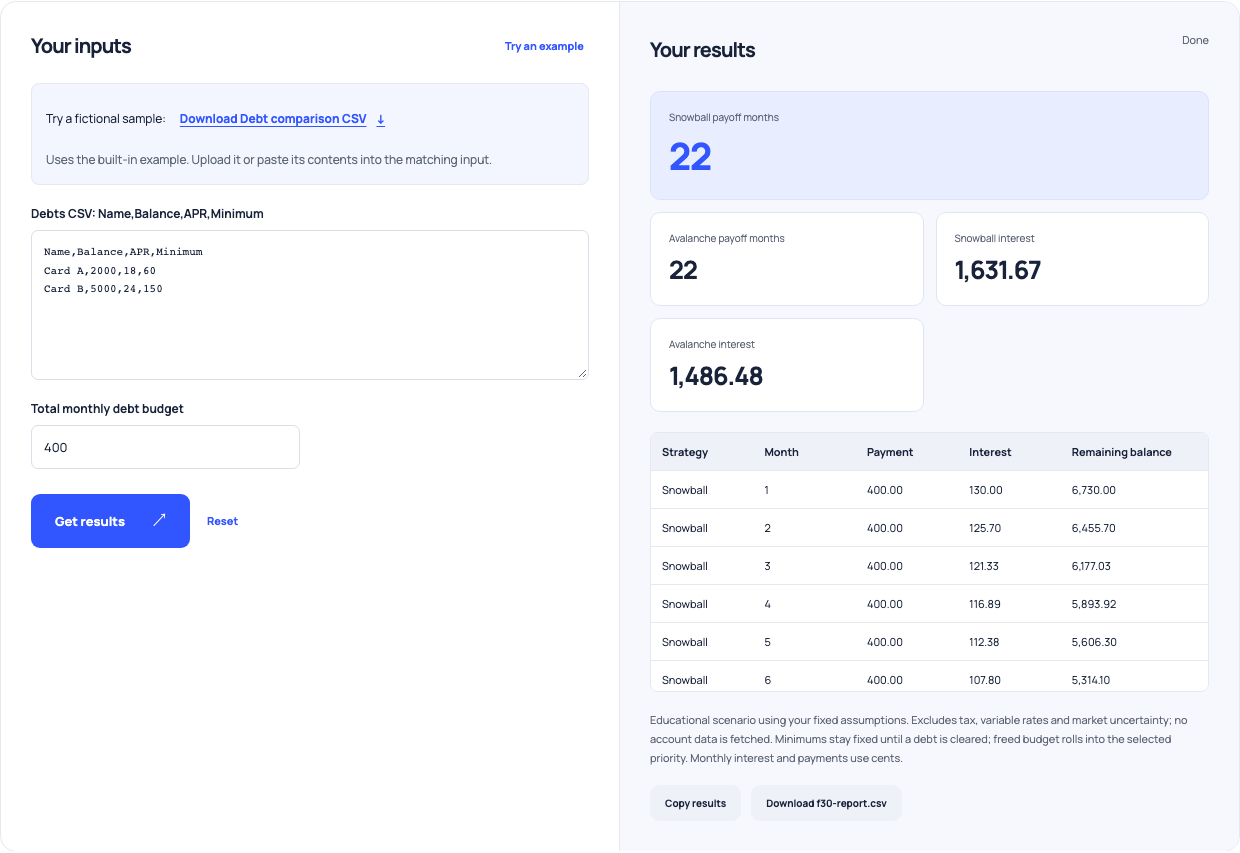
The fictional example has Card A with balance 2,000, APR 18% and minimum 60; Card B has balance 5,000, APR 24% and minimum 150. Total monthly budget is 400, above the combined 210 minimum. In the first month, modeled interest is 30 plus 100, or 130. Paying 400 leaves combined balance 6,730. Later allocation changes the interest path even though the monthly budget remains the same.
Compare priorities with the same funds
Snowball directs extra funds to the smallest active balance after minimum payments. Avalanche directs them to the highest APR. Freed payments roll into the next active priority within the same month. The example reports 22 payoff months for both, with interest 1,631.67 and 1,486.48 respectively. The 145.19 difference is a modeled consequence of order under these assumptions, not a promise that the same exact dates or costs apply to real cards.
| Strategy | Extra-payment priority | Payoff months | Interest |
|---|---|---|---|
| Snowball | Smallest active balance | 22 | 1,631.67 |
| Avalanche | Highest APR | 22 | 1,486.48 |
| Difference | Same 400 monthly budget | 0 months | 145.19 |
Fixed minimums, nominal APR/12 and no new borrowing; actual account behavior may differ.
Use this example Opens Debt snowball versus avalanche with these inputs.
Check whether the plan is feasible
A budget below active minimums is rejected. A plan that cannot repay all balances within 1,200 months is also rejected instead of displaying a misleading payoff date. Review the monthly remaining-balance rows, not only the headline duration. If actual minimums, rates or spending change, update the scenario. A fixed budget is useful for a like-for-like comparison, but it does not determine whether that budget is sustainable for your household.
Use the report to ask better questions
Compare the modeled allocation with each creditor’s actual application rules and statement interest. Keep an emergency expense or irregular bill outside a repayment promise you cannot meet. The calculator is an educational comparison of order and cost; it does not provide individualized debt advice, negotiate with creditors or include every contractual charge. Revisit the model when your balances or available budget materially change.