Savings Goals, Increasing Contributions, Fees and Inflation
Compare reproducible savings scenarios without treating assumed returns as forecasts.
Declare timing and the type of return
These calculators use assumptions you enter, not live rates or product recommendations. Saving growth uses an effective annual return converted to an equivalent monthly rate, with contributions at month end. Increasing contributions rise at the first month of each new modeled year. Keep amounts in one currency and distinguish deposits from modeled growth. Taxes, market volatility and account-specific terms require separate treatment.
Reproduce a contribution-only baseline
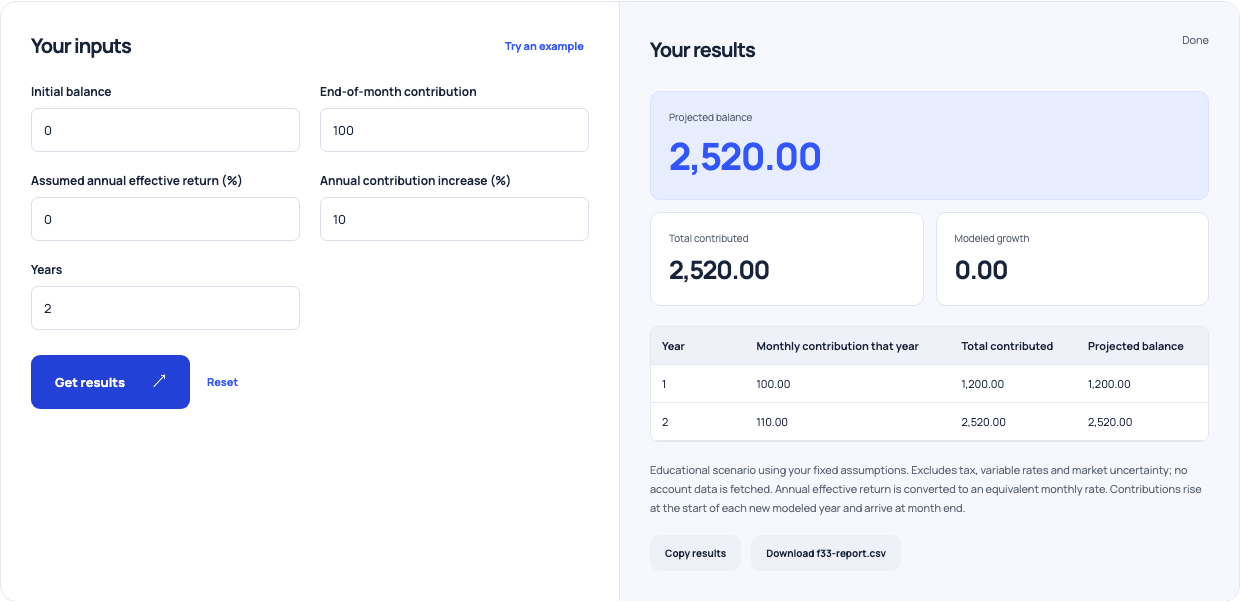
In the savings-goal calculator, set target 1,200, initial balance zero, annual return zero and 12 months. Required contribution is 100 per month. In the increasing-contributions tool, use initial zero, monthly 100, return zero, annual contribution increase 10% and two years. The first year contributes 1,200; the second contributes 1,320 at 110 per month. Ending balance and total contributed are both 2,520 because no investment return is assumed.
Isolate the recurring fee assumption
For a separate fee comparison, use initial 1,000, no monthly contributions, zero gross return, zero contribution increase and one year. Fee A of 0% leaves 1,000; fee B of 1% leaves 990. The model applies annual growth factor (1 + gross return) × (1 − fee), converted to monthly growth. This illustrates proportional recurring fees, not a fund’s exact deduction schedule, sales loads, taxes or trading costs.
| Scenario | Assumptions | Result |
|---|---|---|
| Savings target | 1,200 target; 12 months; zero initial and return | 100 per month |
| Increasing deposits | 100/month, then 110/month; zero return | 2,520 after two years |
| Recurring fee comparison | 1,000 initial; zero return; 0% vs 1% fee | 1,000 vs 990 after one year |
| Inflation | 100 amount; 10% for one year | 110 future nominal; 90.91 present buying power |
Separate fictional examples, not one combined account projection or a return forecast.
Use this example Opens Compound interest with increasing contributions with these inputs.
Translate nominal money into buying power
In the inflation calculator, enter amount 100, annual inflation 10% and one year. Maintaining today’s purchasing power would require 110 in future nominal money. Conversely, an unchanged future 100 has about 90.91 of today’s purchasing power. This is an assumed constant inflation scenario, not historical CPI or your household’s measured price changes. Do not confuse the two directions or subtract an inflation percentage without considering compounding.
Compare scenarios without a promise
The screenshot uses the contribution-only two-year example so every change can be reproduced from deposits alone. Try a return assumption separately and compare how much of the result now depends on that assumption. Keep fees and inflation conventions visible and check that a net return has not had the same fee deducted twice. These are educational scenarios, not guaranteed targets or a professional recommendation about which investment to buy.